
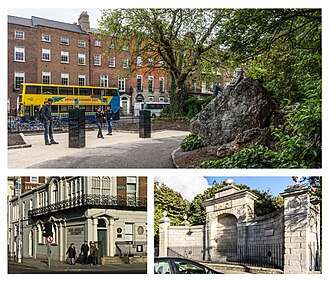
Merrion Square at Dusk: Georgian Terraces & Evening Ghost Tales | Haunted Hidden Dublin
Merrion Square at dusk is a study in contrasts: elegant, symmetrical Georgian terraces that read like a textbook of urban design, and after dark an atmosphere that invites stories—some rooted in recorded social history, others spun from folklore and eyewitness anecdote. This piece is for curious visitors who want a richly textured evening experience: scholars and architecture lovers who value archival clarity, folklorists and storytellers drawn to local legend, and travellers seeking a safe, bookable night walk that honestly separates fact from fancy.
Book an evening ghost walk around Merrion Square
Merrion Square after dark: an introduction to atmosphere and audience
As daylight fades, the square’s broad lawn and classical statues take on a quieter tone. Street lamps pick out the wrought-iron balconies and the tall sash windows of the terraces. For many visitors the appeal is both visual and narrative: the built environment invites explanation, and the night invites stories.
This article is written for adults and older teens who want context before they join a guided tour: what the archives reliably tell us about Merrion Square’s Georgian terraces, what local lore adds to the mood, and how a guided evening walk frames both respectfully. If you’re comparing night tours across Dublin, you may find useful parallels in other after-dark experiences such as those at the Jameson Distillery Bow St (Worker Spirits, Lore & Visitor Guide) or the more overtly institutional legends connected with Kilmainham Gaol After-Hours Inmate Legends — History vs Folklore.
Georgian terraces: documented history and the people who lived here
Documented history of Merrion Square centres on its role as a planned Georgian development: terraces laid out around a private communal garden, built to house the professional and political classes of the era. Building records, property deeds and census returns (where available) show families, professionals and servants forming the social fabric of the terraces.
Architectural records describe common features: uniform façades, balanced proportions, and decorative ironwork. Conservation documents and city planning notes record later adaptations—house subdivisions, Victorian-era changes, and 20th‑century uses—that help explain the terraces’ present-day mix of private homes, offices and cultural institutions.
When we say “documented,” we mean material that survives in public records, museum collections or printed histories: plans, directories, legal records and period maps. On an evening walk we point to these documented facts to ground the narrative: who lived in a particular house according to the archives, what its original function was, and how the street pattern reflected social hierarchies of its time.
Evening ghost tales and local folklore: stories, motifs and how they developed
Folklore around Merrion Square grows from several sources: oral storytelling, Victorian guidebooks that favoured the dramatic, and occasional eyewitness accounts that circulated in print or in conversation. Motifs repeat—unseen footsteps on empty stairs, a solitary figure at a window, or an unexplained coldness near certain garden gates.
These motifs are common to many urban ghost traditions and can be read as cultural reactions to social change: houses that once required many domestic staff later became single-family homes or offices; streets that were once noisy with carriage traffic became quieter at night. Where architecture and social memory meet, stories flourish.
We deliberately label this material as folklore on the walk. Folklore is valuable precisely because it reveals attitudes, anxieties and memory, even when it cannot be proven in the archives. For comparative context, those interested in how local sea-side apparitions or worker legends shape place-based folklore may want further reading on Sandycove’s Forty Foot Apparitions: Sightings, Folklore & Visitor Guide or Jameson Distillery Bow St — Worker Spirits, Lore & Visitor Guide.
Separating fact from fancy: eyewitness accounts, press reports and archival gaps
Experienced guides practice a methodical separation of categories: confirmed documentary fact, credible eyewitness report, and unverifiable legend. A property deed is very different from a dramatic newspaper anecdote. When we present eyewitness accounts, we identify them as such and, where possible, indicate their provenance—for example, whether they appeared in press reports, personal memoirs, or oral testimony collected more recently.
Press reports can be useful but are imperfect: newspapers historically leaned toward sensationalism when a spooky angle attracted readers. Eyewitness testimony is valuable for capturing lived experience but is not a substitute for archival verification. Archival gaps—records lost to time or never created—mean that some stories cannot be conclusively proved or disproved. A responsible night tour points out these gaps rather than pretending certainty.
On our walk, you will hear clear signposting between documented history and tales labelled as folklore or unverified anecdote. That way you can enjoy the atmosphere without conflating entertainment with archival truth.
What to expect on an evening walk: route highlights, storytelling moments and safety
An evening tour typically begins outside the square and follows a route that highlights architectural features—the terraces’ façades, a notable doorway, the private garden perimeter—and the plaques or memorials that mark occupants’ lives. Storytelling moments are staged at places where the built environment naturally supports the tale: a lamplit corner where a reported sighting occurred, or a doorway whose history is well documented.
Guides use evocative but honest narration: they may set a scene with sensory detail—light levels, street sounds, the smell of damp stone—while clarifying whether the story you’re hearing is corroborated by records or rooted in local legend. Expect regular pauses for close-looking at architectural details and for Q&A about what you’ve heard.
Safety is a priority. Routes avoid poorly lit shortcuts, and groups are kept to manageable sizes so everyone can hear and move safely. Weather can change quickly; guides will advise on sensible clothing and footwear in advance.
Respectful visiting: private residences, photography, and community impact
Merrion Square remains a living neighbourhood. Many of the terraces are private homes or working offices. Respectful practice matters: we do not encourage loud behaviour, trespassing, or intrusive photography of private windows. Guides point out public focal points and encourage visitors to observe from public pavements and the square’s designated paths.
If you wish to photograph the façades, please avoid shining lights into windows or using tripods that obstruct footways. Being mindful of residents—especially late in the evening—helps maintain good relations so night walks can continue to operate without community friction.
Tour operators also have a role in community engagement: sharing information about historical preservation or contributing to local initiatives. For operators and groups interested in responsible development of dark heritage experiences, resources such as Grant Sources for Dublin Dark Heritage Projects: Practical Guide for Tour Operators & Groups offer practical advice on funding and best practice.
Practical info & booking: best times, weather, accessibility and how to join a guided tour
Best times for atmospheric walks are early evening to just after dusk, when street lighting complements the terraces without plunging the square into deep darkness. Tours run year-round with seasonal adjustments for start times to match sunset. Guides will advise on weather contingencies; light rain often means the walk still goes ahead with waterproofs recommended.
Accessibility: Merrion Square’s pavements and paths are generally flat, but older curbs and occasional cobbles can present challenges for mobility devices. If accessibility is a concern, contact the tour operator when booking to discuss route adaptations or to arrange a private group option that can be tailored to your needs.
Book an evening ghost walk around Merrion Square — or for tailored arrangements, inquire about private group tours that can be customised for accessibility, corporate groups or study visits.
Additional reading and related walks
Merrion Square sits within a broader web of Dublin’s night-time narratives. For a contrasting kind of waterfront folklore, see Sandycove’s Forty Foot Apparitions: Sightings, Folklore & Visitor Guide. For institutional histories mingled with legend, Dublin Castle: Shadowed Corridors and Sightings — A Visitor’s Guide and Kilmainham Gaol After-Hours Inmate Legends — History vs Folklore provide complementary perspectives. And those interested in worker and industrial lore may appreciate Jameson Distillery Bow St — Worker Spirits, Lore & Visitor Guide.
Conclusion
A well-run evening walk around Merrion Square balances respect for documented history with a relish for local folklore. It gives visitors a chance to appreciate the terraces’ architectural clarity while enjoying stories that enliven the night. If you want a memorable, informed after-dark experience that treats both archive and anecdote with care, booking a guided walk is the best way to ensure quality, safety and community respect.
FAQ
Are Merrion Square ghost walks suitable for families and children?
Yes, many walks welcome families and older children, but content can include themes of death, social hardship and nighttime unease. Parents should consider their child’s sensitivity to ghost stories and check the tour’s recommended minimum age. Some tours are explicitly family-friendly with toned-down storytelling, while others cater to adults and older teens.
How do you separate historical fact from folklore on the tour?
Guides signal the category of each item: documented history is presented with reference to records or physical evidence; folklore and legend are introduced as community stories or eyewitness accounts and clearly labelled as unverified or interpretive. Where possible, guides explain archival gaps so visitors understand what can and cannot be proven.
What should I wear and bring for an evening walking tour in Merrion Square?
Dress for the weather: waterproof outerwear and sturdy footwear are recommended in wet months. Layers are useful because early evenings can cool quickly. Bring a small torch for moving between lit sections, though guides typically manage lighting for the group. A camera is fine, but please respect residents’ privacy when photographing private property.
Are tours respectful of residents and private property around the Georgian terraces?
Yes. Responsible operators emphasise respectful conduct: no trespassing, no loud behaviour near private homes, and no intrusive photography. Guides choose public vantage points for storytelling and encourage guests to treat the neighbourhood as a living community. If you have special requirements or concerns, contact the operator ahead of booking to discuss arrangements.