
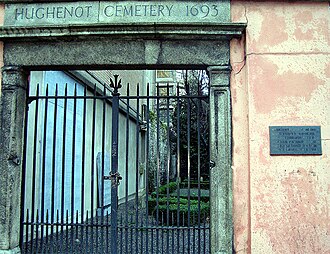
Huguenot Cemetery, Dublin — History, Hauntings & Visitor Guide
The Huguenot Cemetery in Dublin is a compact, atmospheric fragment of the city’s international past: a place where religion, exile and craft intersect. For many visitors it is equal parts historical touchstone and evocative setting for ghost stories. This guide explains what we actually know about the Huguenot presence in Dublin, what stories have grown up around their burial grounds, and how to visit respectfully and safely.
Book a Haunted Hidden Dublin tour to explore this site and other haunted Dublin locations.
Who were the Huguenots?
The Huguenots were French Protestants who followed Reformed traditions. Persecution in France, culminating in the 1685 revocation of the Edict of Nantes, prompted waves of emigration. Some Huguenot families settled in Ireland, including Dublin, bringing skilled trades such as weaving, silk-working and precision crafts.
In Dublin these migrants formed visible communities within the urban fabric. Their churches, businesses and schools influenced local industry and culture. While much of their built environment has changed over the centuries, the Huguenot legacy survives in surnames, industry histories and a number of surviving burial sites and church records that historians use to trace family and economic connections.
The cemetery today: preservation, visible markers and why historians value it
Surviving Huguenot burial grounds in Dublin are typically small and tucked into older neighbourhoods. They often contain simple headstones, family monuments and occasionally inscriptions in French. Conservation efforts vary: some sites are well-maintained by local authorities or heritage groups, while others are quieter, more fragile places that benefit from sensitive stewardship.
Historians and genealogists value these cemeteries for the personal details they preserve: names, family connections, ages and occasional occupation details carved into stone. Even weathered markers help reconstruct migrant networks and community patterns when combined with parish records and trade documents.
Reported hauntings and local folklore
Over the years the Huguenot Cemetery has attracted a small body of local folklore. Common themes include feelings of sudden cold, the sense of being watched, and fleeting shapes seen among gravestones at dusk. Storytellers sometimes describe footsteps on gravel when no one else is present or the impression of a solitary figure lingering near a monument.
Many of these accounts are anecdotal: passed on orally, shared on local walks or repeated in guidebook lore. The cemetery’s small scale and its often-quiet urban setting make it easy for the imagination to fill gaps. Atmospheric details — fog in low light, the groan of old gates, distant traffic — readily become part of a ghost story.
Folklore also links the site to broader Huguenot themes: exile, loss and craft. Some tales imagine sorrowful figures searching for kin who never returned, or the echo of looms and workshops in the night. These motifs are culturally resonant but should be understood as modern narratives layered onto the material remains of the past.
What’s documented vs what’s legend: how to evaluate claims responsibly
Distinguishing documented history from folklore is essential for both visitors and researchers. Documented facts include burial inscriptions, parish registers, wills and trade records. Physical evidence in the cemetery — names, dates and epitaphs — can be cross-referenced with archival sources to build reliable narratives.
By contrast, ghost stories and unverified sighting reports usually lack corroborating contemporary evidence. Anecdotes can be compelling and valuable as cultural history, but they do not substitute for documentary proof. When you encounter a dramatic claim, ask: is there archival material, multiple independent eyewitness accounts, or contemporaneous reporting? If not, treat the story as folklore rather than fact.
For those leading or joining walks, an ethical approach matters. Our field blends history and atmosphere, and responsible storytelling makes the distinction between verified history and imaginative interpretation clear. Guides should cite documents where possible and flag when a tale is local legend. See our short guide on ethics for dark tours for practical standards and guidance.
Ethics for Dublin dark tours — A practical guide for guides & operators
Visitor practicalities: access, etiquette, safety, photography and best times
Access to any Huguenot burial ground in Dublin can vary. Some sites are on public land and openly accessible; others sit within private or church property and have restricted hours. Look for signage on arrival and respect gates and barriers. If a site is locked, do not attempt to enter.
Etiquette is simple: treat the cemetery as a place of remembrance. Keep noise low, stay on paths, avoid standing or walking on graves and do not remove or touch fragile stones. Families and researchers sometimes visit cemeteries for genealogical reasons; allow them space and privacy.
Safety tips: watch your footing on uneven ground and take care in low light. Many atmospheric images are taken at dawn or dusk, but those times can involve reduced visibility and more pedestrian or vehicle traffic. If you plan to photograph, use available light and be mindful of other visitors. For bloggers and content creators hoping to capture atmospheric footage, our budget equipment checklist offers practical, low-cost suggestions.
Budget Equipment Checklist for Dublin Ghost-Hunt Bloggers — Essential Low‑Cost Gear
How to experience the site: joining Haunted Hidden Dublin tours and private options
A guided walk is often the most enriching way to experience the Huguenot Cemetery. Guides combine context with controlled atmosphere, pointing out architectural and epigraphic details you might otherwise miss. Our public walks weave this site into broader routes that explore Dublin’s darker alleys, gates and city walls, allowing you to place the cemetery within the larger story of the city.
If you prefer a specific focus or a private group experience, we offer tailored group tours. These private options are ideal for deeper archival interpretation, family research trips, or photography-focused walks. For bespoke arrangements, ask about private group bookings and how a guide can adapt the route and pace to your needs.
Book a Haunted Hidden Dublin tour to explore this site and other haunted Dublin locations.
Organise a private Haunted Hidden Dublin group tour for a focused visit to this and other sites.
Further reading and nearby routes
If you are interested in pairing the Huguenot Cemetery with other walks, consider routes that highlight Dublin’s urban fabric and haunted corners. The Old Dublin Gates and Alleys Ghost Walk traces narrow lanes and thresholds where social histories meet folklore. The Dublin City Walls After-Dark Ghost Trail places cemeteries and monuments in the context of defensive lines and old suburbs. For Georgian-era stories that intersect with Huguenot urban life, the Baggot Street Georgian Ghost Tales route explores period architecture and its own set of legends.
Old Dublin Gates and Alleys Ghost Walk — Guided history & haunted laneways
Dublin City Walls After-Dark Ghost Trail — History, Folklore & Visitor Guide
Baggot Street Georgian Ghost Tales: History, Folklore & Walking-Guide Stops
Final notes
Visiting the Huguenot Cemetery is an opportunity to connect with a layered, international dimension of Dublin’s past. Approach the site with curiosity, an eye for archival detail and respect for the people remembered there. Whether you come for history, atmosphere or a guided exploration of haunted Dublin, the cemetery rewards a careful and considered visit.
FAQ
Is the Huguenot Cemetery in Dublin open to the public and can I visit on my own?
Access varies by site. Some Huguenot burial grounds are on public land and accessible; others sit on church or private property with set visiting hours. Always check local signage on arrival and avoid entering locked areas. If you prefer certainty, join a guided walk where access and context are arranged in advance.
Have there been documented ghost sightings at the Huguenot Cemetery?
There are anecdotal and folkloric reports of sightings and sensations, but no verified, contemporaneous documentation that meets historical or scientific standards. These stories are valuable as cultural material but should be treated as folklore unless supported by independent evidence.
Can I include the cemetery on a private Haunted Hidden Dublin group tour?
Yes. We offer private group tours that can be tailored to include specific sites such as the Huguenot Cemetery, subject to access and any local restrictions. Please contact our group bookings team to arrange timing, focus and permissions.
What should visitors know to behave respectfully at historic burial grounds?
Keep noise low, stay on paths, do not stand or walk on graves, and avoid touching fragile stones or monuments. Give space to researchers and family members, follow posted rules, and treat photography sensitively. For more guidance on responsible conducting and storytelling on dark walks, see our ethics guide.