
St Mary’s Abbey Ruins: Spectral Echoes — History, Hauntings & Visiting Guide
St Mary’s Abbey ruins stand where history and imagination meet — a fragmentary monastic footprint in Dublin’s urban fabric that invites close-looking visitors to separate archival fact from local folklore. This guide takes a practical approach: it summarises documented history, explains how real events seeded later stories, describes the atmosphere and the “spectral echoes” locals report, and outlines how to experience the site responsibly, especially on a guided Haunted Hidden Dublin night walk.
Book your Haunted Hidden Dublin tour to join a guided walk that places the ruins in historical context and explores the city’s darker stories with care and respect.
At a glance: St Mary’s Abbey ruins — quick facts and location
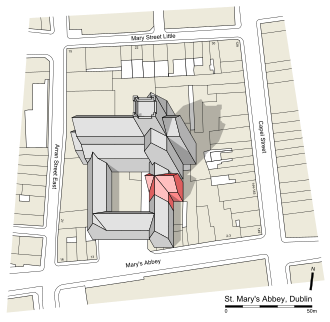
Location: central Dublin, at a site long associated with a medieval abbey. The surviving remains are fragmentary but visible to the attentive visitor.
What to expect: low stone foundations, exposed footings and stretches of masonry in an urban setting — atmosphere over architecture.
Why visit: to see the tangible traces of Dublin’s monastic past and to understand how the city’s medieval upheavals generated later folklore and reported apparitions.
Documented history: foundation, medieval role, dissolution and archaeological remains
St Mary’s Abbey appears in Dublin’s historical record as a sizeable monastic complex established during the medieval period. Surviving references identify it as an important religious institution within the city, with associated lands and burials.
Like many religious houses across Ireland and Britain, the abbey’s institutional life changed dramatically in the 16th century when central authorities suppressed monasteries and redistributed their assets. Contemporary administrative records and later antiquarian accounts describe dissolution, dismantling and reuse of building materials — a pattern echoed at many urban monastic sites.
Archaeological work in and around the site has revealed foundations, stratified deposits and funerary evidence consistent with an ecclesiastical precinct. Those remains now sit within the modern cityscape and are the basis for the visible “ruins” visitors can see today.
From record to rumour: how historical events seeded later folklore
There is a clear chain between historical fact and subsequent storytelling. Large abrupt changes — such as the suppression of a religious community, the removal of buildings and the exhumation or relocation of graves — leave social and emotional traces.
Communities respond to those ruptures by telling stories. Loss of sacred space, public conflict and the presence of graves in densely populated areas all foster narratives about unsettled spirits and strange occurrences. In Dublin these narratives circulated in oral tradition, print antiquarianism and later tourist retellings.
It is important to separate what is documented (dissolution, demolition, archaeological remains) from what is anecdotal (ghost sightings, unexplained noises). The former rests on archival and physical evidence; the latter belongs to living folklore.
Spectral echoes — the most persistent local legends and reported sightings
The phrase “spectral echoes” captures the tone of the most common stories attached to St Mary’s Abbey: impressions of the past reverberating in the present rather than elaborate ghost narratives.
Typical lore reported by locals and visitors includes:
- Shadows or figures glimpsed at dusk near foundation walls, often described as moving “like a procession.”
- Audible impressions: murmurs, chanting-like sounds or the suggestion of footsteps when the area is otherwise quiet.
- A feeling of “coldness” or a sudden drop in temperature experienced by people pausing in certain spots.
- Stories of solitary monks or clerics seen walking the perimeter in period dress, usually reported in personal accounts rather than formal investigations.
These elements fit broader Dublin motifs — recurring apparition types and ambient phenomena found elsewhere in the city — and are explored in pieces such as Dublin Spectral Motifs.
Presented as lore: these reports are part of Dublin’s cultural tapestry. They are valuable as stories that reveal how communities remember place, but they do not replace documentary evidence or archaeological findings.
What visitors can expect: atmosphere, best times to visit, photography tips and respectful conduct
Atmosphere: the site has an uncanny intimacy — fragments of stone in an urban context invite quiet attention. The strongest impressions often come at dusk when long shadows and city light combine to create a contemplative mood.
Best times to visit: late afternoon to early evening offers the most evocative light while still remaining within typical opening hours and safe conditions. If you prefer fewer people, weekday evenings are quieter than weekends.
Photography tips: use a wide-angle lens for context shots that show the ruins against the city. Long exposures at dusk can convey atmosphere; a tripod is useful but be mindful of pedestrian traffic and safety. Avoid flash photos that may disturb others or create misleading effects interpreted as “hauntings.”
Respectful conduct: treat the site as both a historic place and a community space. Do not climb fragile masonry, do not remove stones or artifacts, and avoid loud behaviour. If you encounter local residents or workers, be courteous — the site sits within a living neighbourhood.
Safety, access and preservation: legal access, conservation concerns and sensible visitor behaviour
Access: parts of the ruins lie within public areas while other parts may be on managed land or private property. Always observe signage and respect any fencing or barriers.
Preservation: fragmentary ruins are vulnerable. Foot traffic, climbing and the removal of material accelerate decay. Please refrain from touching fragile surfaces and follow any conservation guidance posted on site.
Legal and safety notes: do not attempt to enter cordoned-off areas, basements, or buried features. Urban ruin sites can mask trip hazards, uneven footing and exposed masonry. Wear sturdy footwear and a headlamp if visiting in low light, and never visit alone in isolated conditions.
How tours approach the ruins: what Haunted Hidden Dublin night walks include and why a guide adds context
Guided walks give layered experience: a knowledgeable guide points out the hard evidence — documentary references and archaeological observations — and then situates the stories that grew around the site. This approach separates fact from folklore while preserving the atmospheric qualities that make the experience memorable.
On Haunted Hidden Dublin night walks, you can expect small groups, careful storytelling, and an emphasis on historical accuracy. Guides highlight primary sources where they exist, explain how folklore developed, and encourage visitors to see “spectral echoes” as cultural echoes rather than as proof of the supernatural.
A guided walk also helps with safety and access. Guides know which areas are public, which are best viewed from a distance, and how to visit without damaging remains. If you prefer a private experience for a group or special occasion, we also offer tailored options — see our private groups page for details.
Nearby dark-history stops to combine with your visit
St Mary’s Abbey sits within a network of Dublin locations where history and legend intertwine. Consider pairing your visit with other after-dark or history-focused stops:
- After-Dark Tales at Glasnevin Cemetery — a deep dive into burial culture and funerary stories.
- Blessington Street Basin — atmospheric waterworks with local encounter stories.
- Dublin’s Cursed Inheritances — a walking guide to ghostly claims attached to properties across the city.
- Terenure Manor House Legends — an example of house-centred folklore you might contrast with monastic narratives.
Book your Haunted Hidden Dublin tour to experience St Mary’s Abbey ruins in a guided, informative way that honours both evidence and folklore. For groups, corporate events or private walks tailored to your interests, learn more about our options at our private groups page.
FAQ
Are the St Mary’s Abbey ruins open to the public and can I explore them on my own?
Parts of the site are visible from public areas and can be viewed without a guide. However, some sections may be fenced or on managed land. Visitors should follow onsite signage and not enter cordoned-off zones. A guided tour provides fuller interpretation and ensures you see the site responsibly.
Have there been confirmed paranormal investigations or documented ghost sightings at the ruins?
There are many anecdotal accounts and local stories describing “spectral echoes” — shadowy figures, sounds and sensations. These remain anecdotal folklore rather than formally confirmed phenomena. Documentation about the abbey itself comes from historical and archaeological sources; reported apparitions are part of living local lore.
Is it safe and appropriate to visit the ruins at night, and does Haunted Hidden Dublin run night tours here?
Visiting at night can be atmospheric but requires caution: uneven ground, limited lighting and urban hazards mean you should avoid wandering alone. Haunted Hidden Dublin runs night walks that include this area on occasion; guided visits balance atmosphere with safety and historical context. Check tour listings and seasonal schedules before you go.
Are the ruins accessible for people with limited mobility and what should visitors bring?
Accessibility varies across the site. Surfaces are often uneven and may not be fully accessible to wheelchairs or those with limited mobility. If mobility is a concern, contact tour organisers in advance to discuss route options. Visitors should wear sturdy footwear, bring a torch for dusk visits, dress for the weather, and carry water. Respect signage and conservation restrictions at all times.