
Trinity College After-Dark: Myths, Uncanny Corners & Night Walk Guide
Trinity College in Dublin is quiet in a way daytime crowds never allow: a combination of stone, spires and centuries of footsteps that catches the light differently after sunset. The same courtyards that feel bustling by day become intimate, sometimes eerie, at night—perfect ground for old stories, echoes, and the imagination. This guide pairs visible facts with the folklore that colours them, and gives a compact 60‑minute route for a safe, atmospheric after-dark walk through the college’s most uncanny corners.
Book your Trinity after-dark myths walk
Why Trinity College feels different after dark
Stone buildings, long corridors and small, enclosed squares change scale once the crowds go. Sound behaves differently—footsteps, a closing gate, the distant hum of the city—so stories that begin by candlelight or in pub booths suddenly make more sense. The college’s combination of public thoroughfares, restricted interiors and an Old Library kept behind doors gives the place a liminal quality: part museum, part university, part stage set for tales.
That feeling creates two useful traveller experiences: one immediate and sensory, and one cultural. The sensory experience—how light and sound transform places—can be enjoyed by any visitor. The cultural layer, the myths and legends tied to corners of the campus, benefits from context. Read on to learn which elements are documented history, and which are local folklore better enjoyed as stories rather than facts.
Fact vs Folklore: How to tell documented history from myth on campus
When you hear a bold or grisly tale about Trinity after dark, pause and ask two questions: what is recorded in official archives or contemporary accounts, and what surfaces purely in oral storytelling? Documented history at Trinity is well preserved in college records, architectural studies and public archives. Folklore circulates in memoirs, tours, pub conversation and late-night webpages.
Practical tip: we label each anecdote below as “Documented history” or “Folklore/Legend” so you can enjoy the atmosphere without confusing entertainment for evidence.
Spotlight corners and their stories
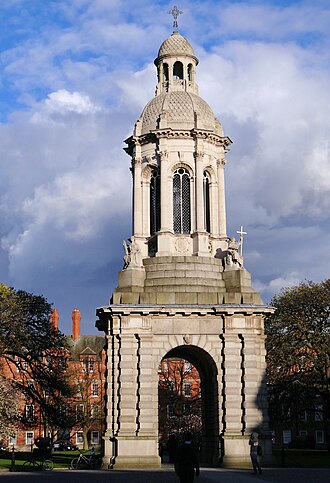
The Campanile
Folklore/Legend: The Campanile is often the subject of ghost stories—tolls that ring themselves at odd hours or the suggestion of a mournful figure on the steps.
Documented history: The Campanile is an architectural focal point and long associated with college ritual rather than unexplained events. Any unusual sounds at night are usually explainable by weather, temperature changes or maintenance work. As with many prominent landmarks, legend grows where a feature is visible and emotionally resonant.
Front Square and Fellows’ Square
Folklore/Legend: Students and locals sometimes tell stories of cloaked apparitions and footsteps in empty squares. Tales often point toward long-ago academic quarrels or tragic romances.
Documented history: The squares functioned as meeting, ceremonial and circulation spaces. Records indicate notable people, ceremonies and changes in use over time, but there is no verifiable archival record that these spaces are haunted. Folklore tends to personify the loneliness of empty squares at night.
The Long Room (Old Library)
Folklore/Legend: The Long Room, with its high barrel-vaulted ceiling and rows of books, invites whispers of wandering librarians and spectral readers who guard forbidden volumes.
Documented history: The Long Room is one of the college’s most famous interiors and houses rare books and historical collections. Public access to the interior is limited and usually restricted to daylight visiting hours; unusual noises at night are most often maintenance-related or from climate-control systems supporting the collection.
Provost’s area and adjacent courtyard
Folklore/Legend: Stories sometimes place a brooding presence near the Provost’s house or suggest secret, unresolved events in the administrative core of the college.
Documented history: The Provost’s quarters and offices are historic administrative spaces. There are documented instances of disputes and controversies in college governance—normal for an institution with a long life—but these are not the same as supernatural claims. Differentiating a contested historical episode from a ghost story is key.
Local folklore highlights: common myths and what the records say
Myth: Secret tunnels beneath campus.
Reality: Many institutions of this age have service passages, cellars or sub-basements. While imaginative maps show elaborate underground networks, sustained evidence for public-access secret tunnels under Trinity is not supported by college floor plans available to researchers and surveyors. Short, practical passages and maintenance access do exist.
Myth: Specific named ghosts tied to particular rooms.
Reality: Personal ghost stories are abundant, but most spring from oral tradition and anecdote. Where an event has a contemporary record—an obituary, court notice or newspaper report—those documents are the place to verify details. If you enjoy tales, take them as folklore unless backed by archival reference.
Myth: The Long Room’s books moving or vanishing.
Reality: The Long Room holds rare items with strict environmental controls. Any movement or conservation work is documented by staff. Rumours of missing tomes are usually embellishments of conservation activity or inventory checks.
Suggested 60-minute after-dark walking route
This short route keeps you on public paths and near illuminated façades for safety and best atmosphere. Timings are approximate; adjust for your pace and stopping time for stories.
- Start (0–5 minutes): Enter at the main gate and take a moment at the threshold—notice how the city and college feel like two different scales. Brief orientation and a first story about the campanile.
- Campanile stop (5–15 minutes): Pause under the tower. Share the documented uses of the bell and the folklore connected to it; discuss how weather can create unexpected sounds.
- Front Square walk (15–25 minutes): Circle the square, point out architectural details and compare recorded events (ceremonies, historical uses) with local tales about apparitions or lonely footsteps.
- Fellows’ Square (25–35 minutes): Take a slow loop and tell one or two short legends, clearly labelled as folklore. Explain the administrative history of the surrounding buildings.
- Long Room (exterior) (35–45 minutes): View the Old Library from outside. Discuss documented collections and the limitations on access after hours, then tell a book-related folktale as atmospheric, not factual.
- Provost’s area (45–55 minutes): Walk the perimeter and explain the documented governance role. Share stories, indicating where archivals stop and oral tradition begins.
- Finish (55–60 minutes): Conclude at a well-lit exit or nearby public space. Offer final context and signpost related evening routes in the city.
If you want to extend your exploration, nearby themed routes such as our North City laneways or seaside lore walks provide more dusk and night-time material; see North City Laneways: Whispering Doors & Strange Shadows and Bull Island and Dollymount: Ghostly Seaside Lore and Walking Guide.
Practicalities: safety, photography, access, and when to avoid wandering alone
Safety first. Stick to well-lit paths and avoid entering restricted or private areas. Trinity is a working campus and certain buildings are closed to visitors after hours. The Long Room and other archival spaces are typically not accessible at night—expect exterior viewing only.
Photography: Night-time photos can be atmospheric, but be considerate: use sensible lighting and avoid intrusive flash in residential or administrative areas. Tripods and professional setups may require permission.
Permissions and permits: If you plan to run a commercial or large group activity, or want to film or use professional equipment, check requirements in advance. For practical guidance on permits, insurance and legal considerations for night walks in Dublin, consult our Insurance & Permits Checklist for Dublin Night Walks (Practical Guide).
When to avoid wandering alone: If you are unfamiliar with the city at night, or if the walk leaves lit public routes to follow lesser-used lanes, join a small group or guide. Several nearby sites with darker histories, such as Mountjoy Prison, have their own layers of atmosphere and should be approached with the same care—see Mountjoy Prison — Unexplained Echoes and Sightings in Dublin’s Dark History if that interests you.
Permissions, group options and how to book a guided or private after-dark tour
We offer scheduled public evening walks as well as private and group options for bespoke times and storytelling focus. A guided walk adds archival context, safe routing and narration that separates folklore from documented history so you get both the atmosphere and the facts.
Book your Trinity after-dark myths walk
For private groups, school visits, or corporate bookings, we can create a tailored route and manage permissions where needed. For those arrangements, see our private group options at Private group bookings and tours. We also recommend experienced guides for any route that ventures into narrow lanes or late-night sections; for other evening-themed walks, consider pairing your Trinity visit with topics like the Abandoned Victorian Cinemas of Dublin.
FAQ
Is Trinity College open for visitors after dark and can I walk the campus alone?
Trinity’s main campus is a mix of public and restricted spaces. While some outdoor areas are accessible at night, many interiors and visitor attractions are closed after hours. Walking alone is possible in public thoroughfares, but for safety and fuller context we recommend joining a guided tour or staying with a group.
Are the ghost stories at Trinity based on documented events or purely folklore?
Most ghost stories are part of oral tradition and local folklore. Where stories align with contemporary records—such as notable incidents documented in newspapers or college archives—they become part of documented history. Our guide highlights which is which so you can enjoy tales responsibly.
Can I take photos during an after-dark visit and are any areas off-limits?
Casual photography of public spaces is generally permitted, but interior and conservation areas like the Long Room are usually closed at night. Professional setups, tripods or commercial filming often require advance permission—see the Insurance & Permits Checklist for details.
Do you offer private or group after-dark tours and how do I book one?
Yes. We run scheduled evening walks and can arrange private or group tours with custom timing and themes. To reserve a spot on a public walk, Book your Trinity after-dark myths walk. For private group bookings, visit our group tours page at Private group bookings and tours.