
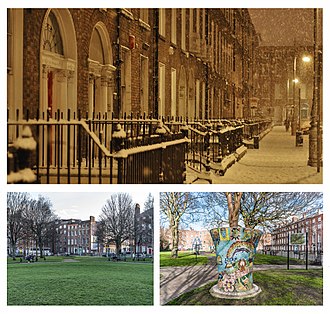
Mountjoy Square Ghost Tales: Georgian Terrace Spectres — Visitor Guide
Mountjoy Square is one of Dublin’s most atmospheric Georgian garden squares: elegant terraces ring a central park, and the layered history of building, decline and restoration has given the place both a visible fabric and a fertile imagination. This guide pairs the verifiable social and architectural story of the terraces with the local ghost tales that have grown up around them, and it aims to help visitors tell what is documented from what is folklore while offering practical tips for a respectful and memorable visit.
Book a Haunted Hidden Dublin Mountjoy Square ghost walk — secure your spot on our guided tours
Why Mountjoy Square draws ghost tales
Squares framed by uniform Georgian terraces have an inherent theatricality: a disciplined façade hides countless private lives, and the central garden creates a stage for both daylight walks and long shadows after dark. In Mountjoy Square those qualities are intensified by its history of changing uses—grand townhouses, tenements, institutional accommodation and later conservation efforts—so the square feels like a place where many stories can accumulate.
Physical atmosphere matters: gas lamps, narrow entrances, basement vaults and layered stonework all lend themselves to rumours and late-night imagination. Ghost stories tend to thrive where the built environment suggests thresholds—doorways, cellar steps and railings—that hint at entry, exit and unseen presence.
The Georgian terrace: building, notable uses and changes over time (documented history)
Mountjoy Square’s terraces were constructed during Dublin’s Georgian development. The façades follow Georgian principles: symmetry, proportion and classical restraint. Originally designed as family townhouses facing the square’s central garden, many of the houses have seen multiple uses since first occupation.
Documented changes include conversion from private residences into multi-occupancy homes and tenements in periods of social and economic pressure, later municipal or institutional uses in places, and more recent conservation-led restorations. Architectural features such as raised basements, stone steps, fanlights and iron railings remain legible, though many interiors were altered when houses were subdivided. Conservation efforts in the late 20th and early 21st centuries have sought to reclaim and stabilise the terraces, while also adapting them for modern use.
Verified social history
On the record are patterns familiar across central Dublin: the square saw affluent residents give way to denser, lower-rent occupation as the city’s needs shifted. Records and council archives document property ownership changes, rates and refurbishment grants; local newspapers recorded court hearings, public meetings and civic restoration projects. Those archival traces are the backbone of any historical account and distinguish the square’s verified evolution from later stories that attach dramatic incident to specific houses.
Recorded events and social history linked to the square — what is on record vs speculation
What is on record includes property lists, planning and conservation documents, census snapshots that show how households changed, and municipal actions regarding the square’s upkeep. Newspaper archives also carry reports of fires, criminal investigations or civic debates when they occurred, but these should be read carefully: not every sensational anecdote turns up in archival sources.
Speculative claims—especially brief, vivid tales of singular violent events tied to a particular door—often lack documentary corroboration. Where an event appears only in oral retellings or tour anecdotes without archival mention, it should be treated as folklore until verified. That approach keeps historical narrative honest while still allowing the square’s stories to be appreciated for their cultural resonance.
Folklore and oral tradition: the spectres, common motifs and how the stories evolved
Local oral tradition supplies the square with several recurring spectres: a grieving woman walking the railings, a shadow in a basement window, the sound of distant footsteps and sometimes music drifting faintly from an empty house. These motifs—lamentation, liminal spaces like basements and stairwells, phantom footsteps—are common in urban folklore and fit naturally with Mountjoy Square’s built landscape.
Over time the stories have accreted detail. A whispered “lady in grey” may gain a name; an unexplained cold spot becomes a named “haunted” room. Tour-tellers pass on the most cinematic elements and sometimes combine separate tales into a single narrative. That evolution is typical of oral tradition: it reflects social memory more than documentary truth, and it often reveals community anxieties about poverty, loss and abandonment rather than literal accounts of supernatural events.
Musical motifs occasionally feature—ghostly strains from a vanished music room or the echo of a pianoforte—linking civic pastimes to spectral imagination. For similar echoes elsewhere in the city, see our piece on Spectral Musicians: Ghostly Echoes in Dublin’s Old Music Halls, which explores how music feeds haunting stories.
Separating fact from legend — how to judge eyewitness claims and historical evidence
Judging eyewitness accounts requires both scepticism and an appreciation that personal experience can be meaningful even when not strictly verifiable. Start by asking: is there archival corroboration? Are the details consistent across multiple independent accounts? Could environmental explanations—reflections, drafts, building settling noises—account for the observation?
Eyewitness claims that hinge on a single telling and that include narrative flourishes should be treated as anecdotal. Those repeatedly reported by independent witnesses, or those that can be linked to documented events (a well-attested death, for example), deserve more attention. When researching, look for municipal records, newspapers and conservation dossiers rather than relying solely on secondhand retellings.
For subterranean stories and vault legends, consult sources that discuss Dublin basements and tenement histories; our page on Cellar & Vault Hauntings beneath Dublin Tenements situates those narratives within the real risks and uses of below-ground spaces.
On the ground: mapped spots in the square tied to ghost tales and what to look for
Visitors should approach the square as a small landscape of thresholds. Key places to observe are:
- The central garden and its perimeter railings—stories often place sightings here at dusk and in winter evenings when sightlines are longest.
- Raised basements and their external steps—these liminal spaces are frequent settings for tales and are architecturally distinct features of the terraces.
- Entryways and fanlights—many anecdotes describe feeling watched at thresholds or seeing reflections in fanlight glass where no obvious source is present.
- Empty or renovated terraces—changes in use often prompt stories that tie a new function to an old legend; examine plaques or conservation signs for documentary context.
When you visit, take time to read notices and conservation information and to compare what you see with what you hear. A steady, sober look at the physical fabric of the square will often illuminate why certain spots attract story-telling.
Visitor practicalities: best times, safety, accessibility, photography and respectful conduct
Best times: early evening provides strong atmosphere without the challenges of late-night safety; daylight visits let you appreciate architectural detail. Weather in Dublin can change quickly—bring layers and waterproofs.
Safety and accessibility: the square is a public park surrounded by sidewalks and terraces. Wear sensible shoes for wet stone steps and uneven pavements. Many entrances have steps and raised basements—if you need step-free access, plan your route in advance and ask a guide about accessible options.
Photography: photographing façades, the garden and public spaces is permitted, but be mindful of private property and resident privacy. Use discretion with flash near residential windows and avoid lingering at doorways or filming occupants. Respectful conduct means treating the square as both a heritage place and a living neighbourhood.
Tours and bookings: what a Haunted Hidden Dublin Mountjoy Square walk includes and booking options
A Haunted Hidden Dublin Mountjoy Square walk pairs on-the-ground observation with clear-minded history. Our guides separate verified archival facts from local legend, point out architectural features that explain many tales, and narrate the folklore in context so you can enjoy the atmosphere while understanding the evidence.
Typical tour elements: a short historical introduction, a walk around the square tracing stories attached to specific spots, a discussion of archival sources versus oral tradition, and time for questions and photographs. Tours are designed to be compact and visitor-friendly; they are suitable for most adults and curious teens.
Book a Haunted Hidden Dublin Mountjoy Square ghost walk — secure your spot on our guided tours
If you are planning a private or group visit, we can create an adapted experience—see our private groups option for bespoke bookings: Private and group tours — arrange a tailored Mountjoy Square walk. Private groups can request a focus on the square’s architecture, its tenement history, or an extended walk that links to nearby dark-history sites.
For visitors interested in exploring broader themes of Dublin’s hidden places, our articles on related subjects can enrich your understanding: read about subterranean lore in Cellar & Vault Hauntings beneath Dublin Tenements, or see how music fuels hauntings in Spectral Musicians: Ghostly Echoes in Dublin’s Old Music Halls. If you keep a blog or photo record of your visits, our practical resources on digital projects may help—browse tips on Affordable stock photos for Dublin dark-history posts — budget sources & tips and hosting at Budget Domains & Hosting for a Dublin Dark-History Blog.
Respecting narratives and neighbours
Hauntings are cultural expressions as much as they are claims about the unseen. When you engage with Mountjoy Square’s stories, do so with curiosity and humility. Ask permission before photographing private doorways at close range, avoid trespass into private gardens or buildings, and be mindful that many of the terraces are family homes or professional premises. A village of stories thrives best when visitors act as considerate guests.
Book a Haunted Hidden Dublin Mountjoy Square ghost walk — secure your spot on our guided tours
FAQ
Are the Mountjoy Square ghost stories true or based on historical fact?
Many of the stories are rooted in oral tradition and local memory rather than in archival records. Some accounts align with documented social history—such as changes in occupancy and tragic personal events—while many vivid spectral details are folkloric embellishment. Our tours explain which elements are documented and which belong to legend.
Is it safe to visit Mountjoy Square at night and can I join a guided tour?
Mountjoy Square is a public urban square and is generally safe for visitors who use common-sense precautions (stay in well-lit areas, travel with companions when late). Haunted Hidden Dublin offers guided walks that run in the evening and provide company, local knowledge and practical safety guidance—book online to secure a spot.
How long is the Mountjoy Square ghost walk and do I need to buy tickets in advance?
Walks are compact—typically around one hour—but can be adjusted for private groups. Advance booking is recommended, especially on weekends and during festival periods, to guarantee your place. Use our main booking page to reserve tickets.
Can I arrange a private or group tour focused on Mountjoy Square and nearby dark-history sites?
Yes. We offer private and group bookings with tailored content and timing. For bespoke routes, extended neighbourhood walks or themed tours, contact our private groups team via the private bookings page to discuss options and availability.