
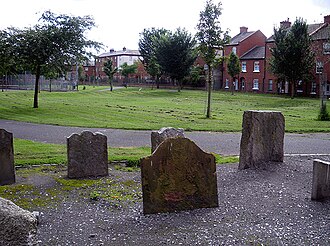
Cabbage Garden burial ground legends, Dublin — History, Folklore & Visitor Guide
The Cabbage Garden burial ground in Dublin occupies a small, quiet pocket of the city that draws visitors who are curious about the past and those who are fascinated by darker stories. Tucked away behind streets that hum with everyday life, the site invites questions about community, loss and the way places collect tales. This guide separates documented history from local folklore, explains how the graveyard is cared for today, and offers practical advice for visitors — particularly those joining one of our Haunted Hidden Dublin evening walks.
Book a Haunted Hidden Dublin walking tour — include the Cabbage Garden on your next evening walk
Documented history: what the records tell us (and what still needs checking)
When researching the Cabbage Garden burial ground, the reliable starting points are parish records, contemporary maps and estate surveys. These primary sources indicate when a plot was in regular use for burials, how it related to the surrounding parish or institution, and often reveal changing boundaries as the city expanded.
Established facts about the site are typically sourced from burial registers and old Ordnance Survey or estate maps. These documents confirm that the ground functioned as a community burial place rather than a private mausoleum, and that its use evolved as Dublin’s population and municipal arrangements changed. Where claims go beyond those records — for example, dramatic individual stories attached to particular stones — they often require further archival confirmation in local parish registers or municipal burial registers.
Researchers and visitors should be clear about the difference between primary confirmation and well‑repeated claims. If you plan deeper research, local archival centres, parish offices and digitised map collections are the most dependable avenues for verification.
Notable burials and historical anecdotes
Recorded uses of the Cabbage Garden reflect ordinary community life: burials of infants and adults, memorials for local families, and interments linked to nearby workplaces or institutions. The ground served its parish community rather than national figures, making its character one of local memory rather than civic commemoration.
Community context matters. Urban burial grounds like this one were often the final resting place for neighbourhood residents and could reflect periods of heightened mortality — for example, during outbreaks of infectious disease or times of economic distress. These patterns are visible in registers as clusters of interments and in contemporary accounts that describe pressure on burial space.
It is important to distinguish recorded facts from popular retellings. Local anecdotes that attribute specific, sensational incidents to named graves often derive from oral history or newspaper gossip rather than primary register entries. Where a family name appears on a surviving stone, that stone confirms the presence of a burial, but it does not by itself prove the fuller narrative sometimes attached to it.
Legends, ghost stories and urban myths
Folklore around the Cabbage Garden is a rich part of its identity. Common themes include unseen footsteps among the headstones, the sound of weeping in the night, and spectral figures glimpsed at the edge of lamplight. Stories often personify the site as a place of unresolved sorrow, and some local tales link particular stones to tragic romances or sudden, violent deaths.
Labelled clearly as folklore: these are cultural expressions rather than documented events. Oral tradition and urban myth thrive in places where memory and mystery overlap. Tales grow through repetition, each storyteller adding texture, tone and occasionally new detail.
Assessing folklore against the historical record usually shows a gap. Registers and contemporary reports rarely corroborate the dramatic specifics of ghost stories. That does not make folklore worthless — on the contrary, it reveals how communities process grief, change and the uncanny. Our approach is to present these narratives as part of the site’s living heritage while noting where archival evidence supports or contradicts the story.
Conservation, archaeology and modern management
Smaller burial grounds are often fragile landscapes: worn sandstone, eroded inscriptions, and shallow graves disturbed by decades of urban development. Conservation typically involves stabilising monuments, managing vegetation to prevent root damage, and recording inscriptions before they fade entirely.
Archaeological intervention is careful and limited in urban graveyards because of the ethical and legal responsibilities around human remains. Where investigations have occurred elsewhere in Dublin, they were carried out under licence with oversight from conservation professionals and in consultation with community stakeholders. For reliable, verified information about any survey or conservation work, consult official heritage bodies, local archives or parish representatives rather than second‑hand accounts.
Visitor guide: practical tips for seeing the Cabbage Garden
Access: The burial ground can be small and enclosed; access may be restricted at certain times. Always check current access arrangements before you set out. Respect any signage or gates — they exist to protect fragile fabric and the dignity of the site.
Etiquette: Treat the ground as you would any cemetery. Keep your voice low, avoid walking over graves and do not lean on or attempt to climb monuments. Do not remove or rub inscriptions; take photographs instead. If you encounter other visitors, give them space and privacy.
Photography and recording: Daylight is best for reading inscriptions and capturing atmosphere. If visiting at dusk, consider a torch with a red filter to reduce disturbance. Avoid using tripods on fragile ground and never clear vegetation from a stone to improve a shot — that work belongs to conservation professionals.
Safety for evening visits: Small sites can feel exposed after dark. Wear sensible footwear, dress for the weather, and be aware of local footpaths. If you feel uncomfortable, join a small guided group rather than visiting alone. For a structured experience that balances atmosphere with safety and responsible interpretation, consider an evening walk with a guide.
Experience it on a tour
The Cabbage Garden makes a compelling stop on Haunted Hidden Dublin walks because it combines a quiet, preserved space with a powerful sense of neighbourhood history. Our guides frame the site with both documented facts and the folklore that surrounds it, helping visitors understand where story and record diverge.
For visitors who want to explore more of Dublin’s darker corners in the same evening, we link the Cabbage Garden with nearby themed walks and essays on local memory. If you enjoy laneways and urban whispers, see our Donnybrook After-Dark Laneways Trail — Historical Evening Walk in Dublin. For encounters with open‑space atmospheres and odd sounds, our piece on Fairview Park at Dusk: Encounters, Unexplained Sounds & Visiting Guide is a helpful read. For an oral history approach to hauntings, Tracing Unseen Voices: Oral Histories of Dublin’s Hauntings explores how stories are recorded and repeated. We also offer thematic routes that range from post‑war social memory in Ballymun Tower Echoes to industrial echoes in Inchicore Industrial Ghosts: Factory Tales & Urban Echoes.
Book a Haunted Hidden Dublin walking tour — include the Cabbage Garden on your next evening walk
If you are organising a private group or a customised itinerary, we can include the Cabbage Garden in a bespoke Haunted Hidden Dublin route. For group bookings and tailored experiences, contact our private tours team: include the Cabbage Garden on your next private tour.
Final notes: respect, enquiry and curiosity
The Cabbage Garden burial ground is at once a place of historical record and a canvas for local imagination. Visiting with sensitivity and an enquiring mind allows both aspects to be appreciated: the sober testimony of burial registers and the rich, evolving folklore of the neighbourhood. Whether you come for history, atmosphere or the thrill of an evening walk, the site rewards quiet attention.
FAQ
Can I visit the Cabbage Garden burial ground on my own, and is it open to the public?
Many small burial grounds are accessible to the public, but access arrangements vary. Gates may be locked at night or during maintenance. Check local signage and, where possible, confirm opening times with the relevant parish or local authority. If in doubt, a guided tour offers guaranteed access and interpretation.
Are the ghost stories about the Cabbage Garden based on documented events or local folklore?
The ghost stories are primarily local folklore. While the burial ground’s records show who was interred there and when, sensational details in many tales tend to come from oral tradition rather than contemporary documentation. We present these stories as cultural narratives alongside verified historical facts.
Is it safe to visit the Cabbage Garden after dark, and do you recommend a guided tour?
Visiting at dusk or after dark is atmospheric but requires caution. Low light, uneven ground and limited sightlines can make lone visits risky. We recommend joining a small guided tour for safety, context and conservation‑aware access — and you can book tours that include the Cabbage Garden via our main tour page.
Can I include the Cabbage Garden on a private or customised Haunted Hidden Dublin group tour?
Yes. We can include the Cabbage Garden on private and customised group tours where access and scheduling permit. For tailored group bookings, please enquire through our private tours page to discuss timing, size and interpretive focus.