
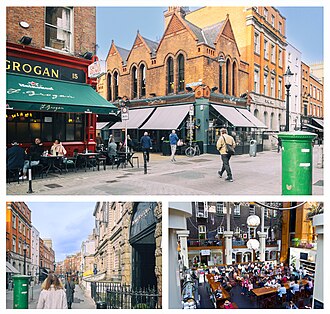
Powerscourt Townhouse has long drawn visitors for its Georgian façades and hidden interiors — and for a particular whisper in Dublin’s dark‑history circuit: accounts of “phantom diners” whose cutlery, laughter and low conversation seem to come from an empty dining room. Whether you come for atmosphere, architecture or a skeptical investigation, the Powerscourt phantom diners matter because they sit at the crossroads of verifiable urban history and the storytelling traditions that shape how Dublin remembers its past.
Book a Hidden Dublin walking tour to explore Powerscourt Townhouse and other dark-history sites — https://www.hiddendublintours.com/tours/
Powerscourt Townhouse through time: ownership, uses and architectural changes (documented history)
Documentary traces of Powerscourt Townhouse are strongest where any urban townhouse’s paper trail is clearest: property records, leases, planning files and trade directories. These establish that the building was constructed as an urban residence, later adapted for commercial use, and has undergone a series of restorations and refits that changed room layouts and circulation patterns.
Architectural features typical of Dublin townhouses — tall windows, narrow plan, stacked reception rooms and a main stair — explain much about how sound and movement behaved historically. Where the archival record is explicit, it confirms the existence of formal dining rooms and service spaces that would have been used for meals and entertaining. Where the record is silent, later uses (retail, exhibition, hospitality) are visible in planning notices and conservation reports that note interventions to interiors and services.
This patchwork of urban uses matters because the house we see today is the result of layers: original domestic architecture, later partitions and openings, and recent conservation decisions designed to make the space accessible to the public. Each layer alters how people move through the building and how sounds travel.
When the diners appeared: earliest press reports, guidebook mentions and verifiable eyewitness accounts
Stories of phantom diners emerge in several formats. Older guidebooks and press items passingly refer to unusual noises and “unexplained” atmospherics in historic houses; oral testimonies gathered by local historians and by tour operators supply the more detailed contemporary accounts. Modern eyewitness reports most often describe hearing distinct dining-room sounds — cutlery clinking, the murmur of conversation, chairs scraping — and occasionally the scent of cooking without a visible source.
Verifiable eyewitness accounts are comparatively few and typically observational rather than evidential. Visitors sometimes record audio or take photos, but these media rarely produce clear corroboration: most captured sounds are ambiguous and photographs show empty rooms. That pattern — vivid subjective experience, limited objective confirmation — is common across many urban legends.
Separating fact from folklore: which elements are supported by records and which are later embellishments
Documented facts: the building’s original layout included formal dining spaces; the site’s ownership and uses have changed over time; restorations have altered acoustics and sightlines. These are directly supported by archival materials and physical inspection.
Folklore and later embellishment: recurring, fully staged dinner parties populated by period-costumed guests, or continuous nightly apparitions, are elements that appear primarily in retellings and popular articles rather than in the public record. Long, cinematic narratives that give named characters, precise dates, or dramatized interactions are typically the product of oral tradition and creative storytelling rather than primary documentation.
It helps to treat the two tracks separately. The building’s material history explains how sensory experiences arise; the folklore demonstrates how communities create meaning from those sensations. Both are legitimate subjects of study, but they belong to different evidential registers.
Possible non-supernatural explanations: building acoustics, theatrical echoes, restorations and memory effects
There are several plausible, non‑paranormal explanations for the phantom‑diner reports.
- Acoustics and sound transfer: Historic townhouses have long circulation shafts, stairwells and concealed service passages. Sound travels unusually well through old masonry and timber, and distant street noise or adjacent businesses can be refracted into interiors. See the discussion of acoustic phenomena in Dublin’s whispering spaces, such as the Casino at Marino whispering rooms, which illustrates how architectural detail can produce apparently localised voice effects.
- Nearby activity: Powerscourt sits in an active urban quarter. Restaurants, cafés and service areas in neighbouring buildings can generate the sounds associated with dining; these sounds may be misattributed to an empty room if incoming guests expect something uncanny.
- Restorations and changing layouts: Works that remove partitions or open up spaces change how sound behaves. A project that introduces new hard surfaces can increase reverberation, making a small noise sound like a full dining-room scene.
- Psychology and expectation: Prior knowledge affects perception. If you arrive expecting a ghostly dinner, ambiguous cues — a clatter, a smell — are more likely to be interpreted as part of a ghost narrative. Social contagion among visitors can amplify what begins as a minor sensory anomaly into a memorable “sighting.”
- Physical sources: Plumbing, heating elements, and building settling produce noises often mistaken for human activity. Odours can come from concealed food outlets or ventilation systems rather than an unseen kitchen.
What remains to see today: site access, visible interiors/exteriors and nearby complementary dark-history stops
Today Powerscourt Townhouse is best approached as an urban historic site with limited public access to certain interiors. Visitors can view the façade, entrances and street elevations, and in many cases a public foyer or café area. Interior access varies by season, opening hours and whether the building is in use for exhibitions or private events.
For a fuller dark‑history circuit, combine a visit with neighbouring stops that explore similar themes: the scholar spectres around Trinity College are part of the late‑night lore of the city (Trinity College late-night scholar spectres, Dublin: History & Night Tour Guide), and the stories of custodians and after-hours keepers resonate with the midnight tales at St Patrick’s (The Midnight Custodian of St Patrick’s Cathedral: History, Legend & Visitor Guide). These complementary stops reveal how place, routine and institutional memory make the city’s shadows meaningful.
Practical visitor advice: best times, safety, photography, and respectful behaviour on a dark-history walk
Best times: early evening or daytime guided sessions usually offer the balance between atmosphere and safe access. If you prefer quiet observation without crowds, visit outside peak retail hours and avoid private-event times.
Safety and access: Powerscourt and its neighbours are part of a busy urban streetscape. Stay on public footpaths, follow signage, and respect any staff instructions. Do not attempt to access private or staff-only areas for the sake of a sighting.
Photography and recording: casual photography of public areas is typically acceptable. If you plan to record audio or video with professional equipment, check with site staff first. Be mindful of other visitors and any posted restrictions. For guidance on ethical storytelling, consent and sources while documenting haunting lore, see our piece on Telling Dublin Ghost Stories Ethically.
Respectful behaviour: avoid sensationalising or disturbing staff and residents. These stories connect to real histories and, sometimes, personal memories — treat them with sensitivity. For ideas on community-minded ways to support local interpretation projects, see Crowdfunding Rewards for Dublin Dark‑History Tours.
Joining a guided experience: how a curated tour adds historical context and safeguards (booking CTA)
A guided walk offers context that raw sensations cannot. Expert guides place sensory reports alongside property records, oral tradition and architectural observation, helping you tell where solid evidence ends and storytelling begins. Tours also negotiate access, ensure safety, and model respectful behaviour toward sites and communities. Book a Hidden Dublin walking tour to explore Powerscourt Townhouse and other dark-history sites — https://www.hiddendublintours.com/tours/
If you’re planning a private group visit or an event with specialised interests, we also offer tailored experiences designed for research groups, history societies and corporate bookings. Enquire at our private groups page: https://www.hiddendublintours.com/group-tours-dublin/
FAQ
Are the phantom diners at Powerscourt Townhouse historically documented or purely legend?
The building’s material history — its dining rooms, service spaces and later alterations — is documented in property records and conservation notes. The specific narrative of nightly, recurring phantom dinner‑parties belongs more to oral tradition and popular retellings than to the archival record. In short: the house’s physical capacity to produce dining‑related sounds is documented; the supernatural framing is folkloric.
Can I visit Powerscourt Townhouse and see the areas associated with the sightings?
Public access varies. You can view exteriors and, depending on opening hours and programming, access some public interiors. Interiors connected to private events or staff areas are not usually available to casual visitors. Check opening hours or join a guided tour for fuller interpretation and managed access.
What non-supernatural reasons might explain the phantom-diner reports?
Acoustic transmission, neighbouring restaurants and street activity, building services (plumbing, heating), recent restorations that alter reverberation, and psychological factors like expectation and social suggestion are all plausible non‑paranormal explanations. These factors often interact, producing vivid but ordinary sensory experiences.
Is it appropriate to photograph or record alleged paranormal experiences at the site?
Casual photography in public areas is usually fine, but recording with professional kit, tripods or intrusive methods should be cleared with site staff. Always respect other visitors’ privacy and any posted rules. If recording for research or publication, obtain permissions and follow ethical best practices as outlined in our guidance on storytelling and consent.